

Introduction
Modern cars use a large number of electronic systems. In fact, a single vehicle can contain more than 250 electronic control units. Each unit controls an important function. And the main part of their functionality depends on rigid flex PCBs. These are a specific type of circuit boards having both rigidity and flexibility inside a single unit.
Why Rigid Flex PCBs are Used in Automotives?
Modern vehicles rely on hundreds of electronic control units. These units control different functionalities of the vehicle. For example, air systems, gauges, monitors, and more. These systems/control units must survive harsh conditions. Because when driving vehicles face:
- Strong and constant vibration
- Large temperature changes
- High humidity
- Oils and other liquids
- Corrosive substances
Because of this, the printed circuit board must remain stable. It must not crack and must not fail during temperature shifts. Also, it should be able to resist chemicals and mechanical stress.
Therefore, manufacturers must choose rigid flex PCB designs. A rigid flex PCB is a type of printed circuit board that has both rigid and flexible sections combined on one unit. They offer both long life and strong performance.

Benefits of Rigid Flex PCBs in the Automotive Industry
The following are the main advantages that rigid flex PCBs provide to the automotive industry.
1. Increased Quality and Reliability
In rigid flex printed circuit boards, fewer connectors and solder joints are used. As a result, they lower the chances of electrical failure. This is because weak points get reduced. Ultimately, you get improved system stability. Therefore, automotive control systems work in a more reliable way.
2. Total System Cost Optimization
The single-unit cost of rigid-flex PCBs is usually higher than that of standard PCBs. However, using rigid flex circuit boards significantly reduces overall system costs. Because flex-rigid PCBs remove the need to solder many cable connections and connectors.
As a result, the number of production steps is reduced. This directly cuts down assembly work. In turn, manufacturers reduce overall production and assembly costs.
3. Simple Maintenance
Flex-rigid PCBs combine rigid sections with flexible sections in one board. This design helps engineers fit the board into small and tight spaces. At the same time, it removes the need for complex handling and upkeep. As a result, maintenance becomes easier and more manageable.
4. Design and Assembly Flexibility
Designers can place the rigid parts where they need them. The flexible parts join the sections together. This makes the design easy. It also makes the assembly easy.

Types of Rigid Flex PCBs Used in the Automotives
Different types of rigid flex PCBs are used in the automotive industry. Each type serves a specific need.
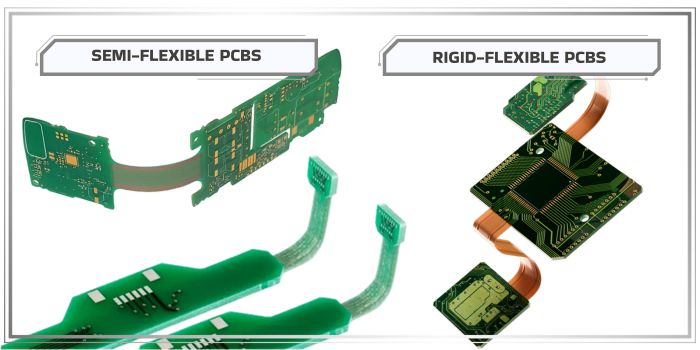
- Semi-flexible PCBs: Thin FR-4 material is used to make these boards. They suit applications that need only slight flexibility. Also, they help keep manufacturing costs lower.
- Multi-flexible PCBs: Manufacturers use polyimide material to make these boards. They are used in electronic applications that require high dynamic flexibility.
Multi-flexible PCBs are based on a hybrid structure having rigid and flexible layers. Electroplated vias connect both these layers. A copper foil on a polyimide substrate makes the flexible section, which protects boards against mechanical stress.
Adhesives must be chosen with care. In multilayer PCBs, some adhesives have a high coefficient of thermal expansion. During thermal shocks or stress, such adhesives can expand a lot and can damage the vias during thermal shock. So, designers should use less flexible material in rigid areas, mainly near the vias.
Important Design Considerations
When designing rigid flex PCBs, several design features should be considered.
Material Selection
You should select the materials that are resistant to tough conditions. Automotive engines experience high temperatures from -40°C to 125°C or even 150°C. Designers should use high-Tg materials. Generally Tg 170°C or higher is required. Also, polyimide is used for flexible sections; it can remain stable in heat and bending.
Bend Radius
You should also take a careful plan for the bending area. Extra bending can crack the flexible layers. It is suggested to keep the bending radius 10 times the flex thickness. As an example, for a 0.1 mm layer, you should go for a 1 mm bend radius.
Thermal Management
Vehicles make a lot of heat, especially near engines and high-power LED lights. This creates thermal stress. And, during automated rigid flex PCB assembly, it is necessary to manage this thermal stress. This can be done by using thermal vias. They aid in the removal of extra heat from critical components on the board. Moreover, copper planes that are 2 oz thick can be added to dissipate heat. Even distribution of heat helps sensors stay accurate within ±0.5%.
Signal Integrity
The modern vehicles employ high frequency signals. So, impedance must be regulated. To achieve a better signal integrity in rigid flex circuit boards, designers usually aim for the following impedance:
- 50 ohms for single-ended signals
- 100 ohms for differential pairs
Each has a tolerance level of ±10%.
Performance Levels Based on Vehicle Location
Automotive industry PCBs are required to resist high temperatures and low temperatures in a vehicle in various regions. It is because every site possesses a different level of temperature cycle.
| Vehicle Location | Temperature Level | Temperature Range | Test Cycles | Applications |
| Interior applications | Level 0 | 85°C ± 2°C | 500 | Inside vehicle cabin |
| Protected areas | Level 1 | -40°C to 85°C | 500 | In protected sections that are not prone to weather |
| Engine compartment | Level 2 | -40°C to 105°C | 1000 | Engine area prone to high heat |
| Near engine components | Level 3 | -40°C to 125°C | 1000 | Engine surroundings |
| Directly on engine components | Level 4 | -40°C to 150°C | 1000 | Direct on engine facing extreme heat |
Role of Rigid Flex PCBs in Modern Vehicle Development
Modern cars include advanced safety systems. They also include electric vehicle systems and autonomous vehicle systems. These systems make electronic systems more complex.
Rigid flex PCB helps in dealing with this complication. They allow compact circuit design. They are small and can be installed comfortably in sensors and other control units. Because of this, manufacturers can build more efficient systems.
However, automotive PCB manufacturers must follow strict quality standards. They comply with ISO9001, IATF 16949 and IPC-6013. These standards help prevent defects and also reduce production errors. Quality control plays a major role in ensuring long service life.
Your Trusted Automotive-Grade Rigid-Flex PCB Supplier
With over 20 years of professional manufacturing experience, MV Flex Circuit is a specialized supplier of flexible PCBs and rigid-flex PCBs for the automotive industry.

- Production Capabilities: Up to 8 layers for flexible PCBs & 20 layers for rigid-flex PCBs, supporting complex automotive electronics designs.
- Automotive & International Standards: Fully compliant with IPC Class 2/3 and strict automotive-grade requirements, certified with ISO, UL, REACH, and RoHS for global market access.
- Full-Range Quality Testing: All our production processes perform 100% E-test, AOI, X-ray, ICT, flying probe, and functional fixture testing to ensure high reliability in harsh automotive environments.
Send us your Gerber files and project requirements. Our engineering team provides a free DFM check and a detailed, customized quote for your automotive rigid-flex PCB project.
Conclusion
Rigid flex PCBs have significant use in the current motor vehicles. They assist manufacturers in integrating and installing boards even in small spaces as well. Rigid flex printed circuit boards can easily resist vibration and thermal stress. However, choosing the appropriate materials and complying with the standards is necessary.


